ORE Studio
In my copious free time, I like to work on computational finance. ORE Studio was born as a general way to condense all of my software engineering work in the field of finance.
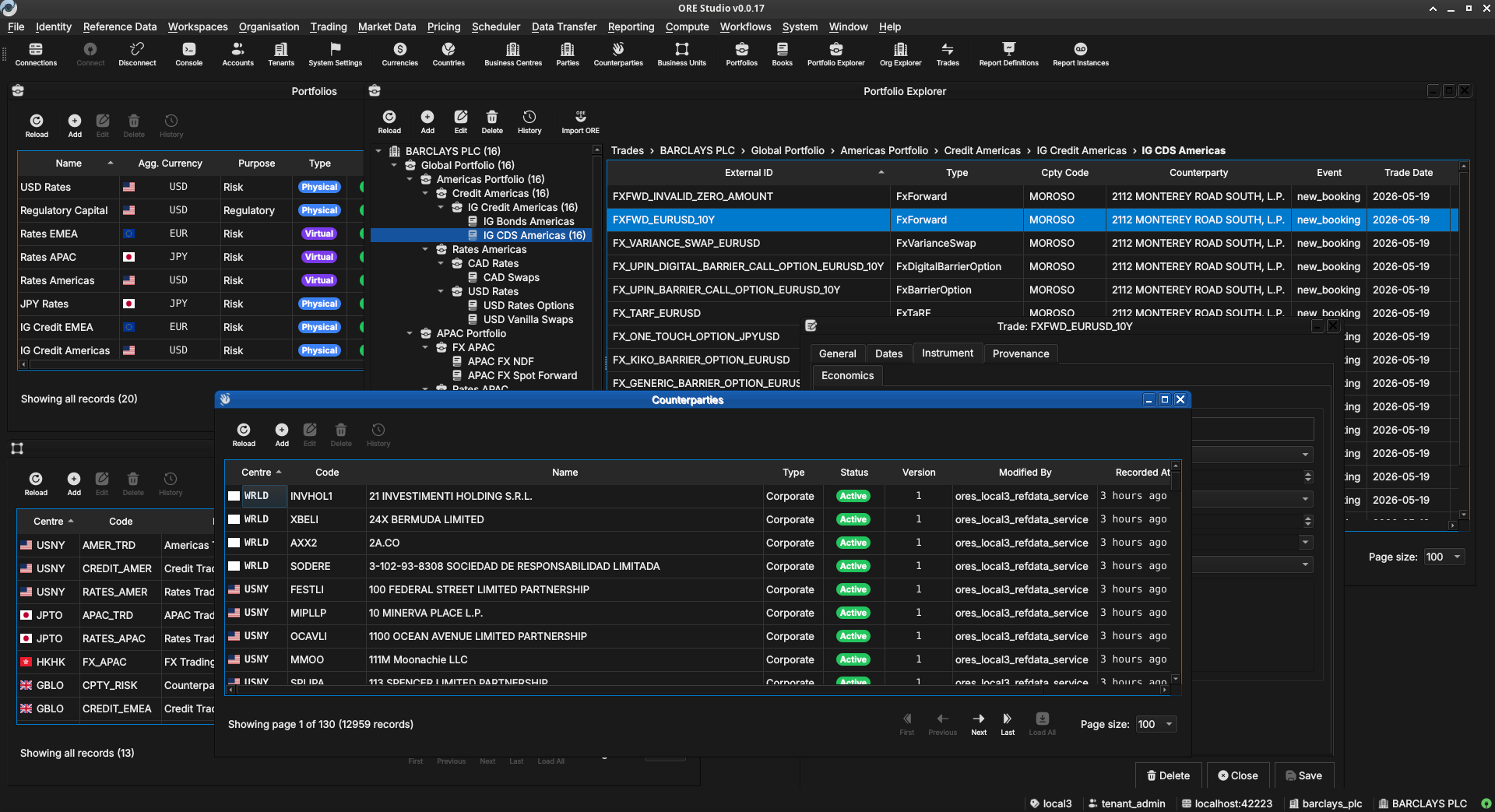 Figure 1: ORE Studio at v0.0.17.
What is ORE Studio
To avoid repeating myself, I will copy verbatim selected portions of the ORE Studio readme:
ORE Studio is a graphical wrapper around Acadia's Open Source Risk Engine (ORE), which itself builds atop of QuantLib. Please note that this open source project has no affiliation whatsoever with ORE or QuantLib, but you cannot understand ORE Studio without at least a basic understanding of both of these projects.
QuantLib is defined as follows:
The QuantLib project (https://www.quantlib.org) is aimed at providing a comprehensive software framework for quantitative finance. QuantLib is a free/open-source library for modeling, trading, and risk management in real-life.
ORE tells us that
The Open Source Risk project aims at establishing a transparent peer-reviewed framework for pricing and risk analysis that can serve as
- a benchmarking, validation, training, teaching reference
- an extensible foundation for tailored risk solutions
Open Source Risk Engine (ORE) provides
- contemporary risk analytics and value adjustments (XVAs)
- interfaces for trade/market data and system configuration (API and XML)
- simple application launchers in Excel, LibreOffice, Python, Jupyter
- various examples that demonstrate typical use cases
- comprehensive test suites
ORE is based on QuantLib, the open source library for quantitative finance, and it extends QuantLib in terms of simulation models, financial instruments and pricing engines.
ORE Studio builds on top of ORE with the eventual aim of providing:
- persistent database storage for all of its inputs and outputs, with basic CRUD support;
- graphical user interface both for data generation as well as data exploration;
- ability to configure and orchestrate ORE execution.
Material
Much like with Dogen, I have started to create assorted material for ORE Studio in different media. Hopefully this list will increase over time. The objective is to give users a broad view of what we are trying to achieve, as well as how the development process is done.
Videos
What follows is a series of videos I have created on ORE Studio.
| Thumbnail | Video | Description |
|---|---|---|
 |
ORE Studio Overview - part 1 | In this video we provide a quick overview of the ORE Project and a quick run through of the UI. |
 |
ORE Studio overview - part 2 | In this second part we address the multiple comments we had from people who have reached out, demonstrate fixing issues using our Claude Code setup and demonstrate the counterparties wizard working correctly. |
 |
ORE Studio Overview - part 3 | In this video we provide an overview of the Karpathian approach we take in ORE Studio, including a brief explanation of AAD which references Micrograd. |
Demos
What follows is a series of sprint demos showcasing the latest development on ORE Studio.
| Thumbnail | Video | Description |
|---|---|---|
 |
ORE Studio: Sprint 17 Demo | A demo of the work completed during Sprint 17 of ORE Studio. |
Articles
What follows is a series of posts on the topic of ORE Studio and related technologies.
| Post | Description |
|---|---|
| Quant Summit London 2026 in Review | Report in the 2026's Quant Summit at the London Stock Exchange. |
Domain Musings
Speculative notes on the finance domain — on money, value, currency, trading and the philosophy of modeling the field. See Domain Musings.